

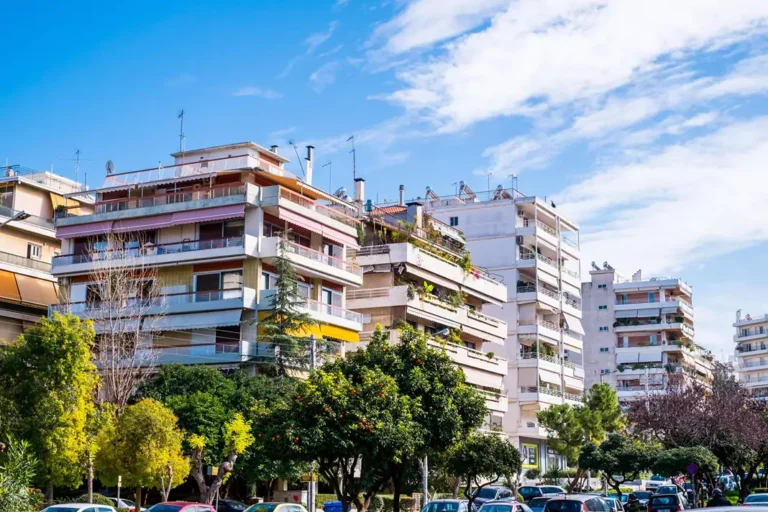
Residential rental yields in Greece continue to hover around 4% to 5%, with regional cities increasingly outperforming Athens and Thessaloniki as years of rapid property price growth compress investor returns.
According to a study conducted by ReDataset, part of the Resolute Group, some of the country’s strongest residential investment returns are currently found outside the two largest metropolitan areas.
Larissa leads with an average rental yield of 7%, followed by Volos at 6%, Patras at 5.9%, and both Heraklion and Ioannina at 5.5%. By comparison, average gross annual residential yields in Thessaloniki remain below 4.3%, while most areas of Athens offer returns of 4%- 5%.
Athens city centre remains the capital’s top performer
Within the Athens metropolitan area, the highest yield is recorded in Agia Varvara at 7.1%, although the district is not generally considered a prime investment destination.
At the opposite end of the spectrum, the upscale coastal municipalities of Vari, Voula and Vouliagmeni generate yields of just 3.2%, as exceptionally high property prices outweigh the benefit of strong rental income.

Athens city centre continues to stand out among mainstream investment locations, offering an average yield of 5.4%, the highest among central districts. Kaisariani follows closely with a yield of 5%.
In the southern suburbs, returns decline as investors move closer to the Hellinikon development zone and the Athenian Riviera. While Kallithea offers average annual yields of 4.8%, returns in Glyfada fall to just 3.1% due to significantly higher acquisition costs.
Northern Athens presents a more balanced picture. Chalandri leads with yields of 4.7%, followed by Kifissia and Nea Ionia at 4.3%. Marousi records the lowest return in the area at 3.8%, despite high rental prices, largely because the local housing stock consists mainly of larger apartments that generate lower returns per square meter.
In western Athens, Peristeri offers yields of 4.4%, while Aigaleo stands out at 5.7% and Haidari at 4.8%. The Piraeus region also continues to attract investors seeking stronger returns. Drapetsona, Keratsini, Nikaia and Agios Ioannis Rentis all generate average yields of approximately 5.1%, compared with 4.7% in the municipality of Piraeus itself.
Property prices rising faster than rents
One commonly used indicator tracks how many monthly rents are required to purchase a property. The higher the number of rents needed, the lower the expected investment yield.

In Athens city centre, investors needed approximately 161 monthly rents to purchase a property in 2019, corresponding to a yield close to 8%. Today, that figure has risen to 212 monthly rents, reducing annual returns to below 6%.
Nevertheless, central Athens remains one of the most attractive investment locations in the Attica region. By comparison, investors currently need around 288 monthly rents to purchase a property in the northern suburbs, 311 in the southern suburbs, 238 in western Athens, 256 in the eastern suburbs, 242 in Piraeus and 221 across the rest of Attica.